I once had a child ask me what was happening in the Tudor period in the United Arab Emirates.
Whilst I was delighted that this student was making connections between what we were studying in history and the region where we were, such a question highlights the need to develop children's understanding of world history.
The timeline that has been created by Little PM has been designed to create a deeper appreciation and understanding of Emirati history and regional history as a whole. Often, timelines that are developed for use in schools focus on the most recent history of the United Arab Emirates beginning either with the formation of the Trucial States in the nineteenth century or the union of the Emirates in 1971. Whilst these are crucial dates in Emirati history, it overlooks the thousands of years of culture that have defined this region and led to the deep and rich history of the Emirati people. It is probably not unfair to say that many teachers who have moved to work in the United Arab Emirates may only have a good understanding of the history of the United Arab Emirates in the 20th century. This timeline, therefore, is an incredibly useful resource for both students and teachers alike.
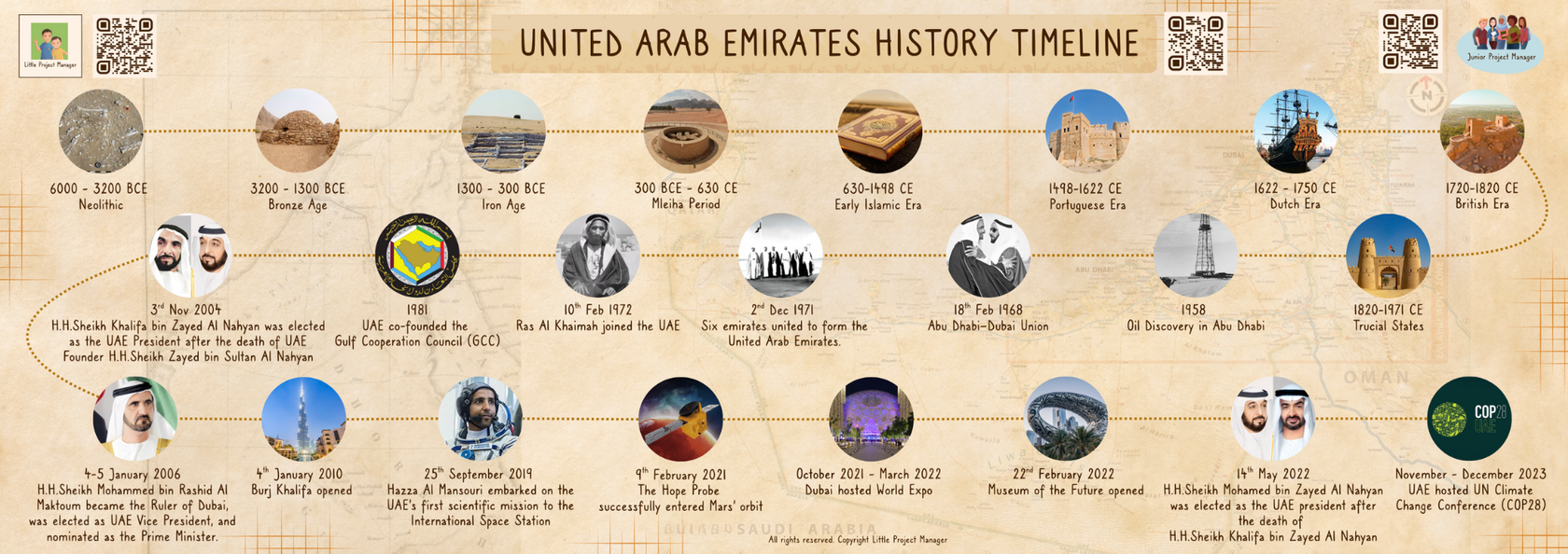
By having a timeline that stretches right back to the Neolithic period, it helps children to develop a stronger sense of chronology and also improves their world mindedness. As we will see later, many children in British curriculum schools will have an understanding of different periods of history, such as the Stone Age, Iron Age and Medieval period. By looking at some of these periods in an Emirati context, it helps children to understand that these periods are not so clearly defined. Rather, they are simply a way for historians to standardise periods of development in the past to simplify communication: what might be considered the Stone Age in Western Europe does not necessarily align with the Stone Age in the Middle East. By having these discussions about naming conventions, it helps children to appreciate that development and innovation were happening at an earlier stage in some parts of the world.
With regards to the Moral, Social and Cultural Studies framework, having a timeline displayed in the classroom helps pupils to engage with many of the key objectives of the curriculum. Most obviously perhaps, objectives within the history strand of the MSC curriculum relate to the timeline. Indeed within Grade 3/Year 4, there is an objective specifically about constructing timelines and the Little PM timeline poster is an excellent example of that. However, beyond the surface level connections, the timeline also helps pupils to look at changes over time in a region, and individuals who have had an impact on history. It also helps pupils discuss ideas related to the heritage strands of the MSC curriculum, for example, talking about one's own cultural identity and how that might have changed over time. There are many objectives in the MSC framework that link to the work of archaeologists and how we can interpret artefacts. Many teachers will, of course, be familiar with key archaeological sites such as the Al Jahili Fort in Al Ain; however, having a timeline to refer to helps make sense of these sites in a wider context of what was happening in the region at the time. Such a timeline alongside a cultural map of the UAE also helps in the teaching of many of the objectives within the Information Processing and Information Literacy strands of the curriculum, for example, being able to select the most relevant information when creating a presentation.
As noted earlier, the history that is taught in British curriculum schools will, for the large part, follow the structure and guidelines of the English National Curriculum from 2014. Whilst there are aspects of this curriculum that focus on non-European societies and general changes over time, it remains true that this is a very Anglo-centric curriculum. It is important for all children to have a diverse education but this is even more true for children who are living and learning in an international context. It is the duty of teachers in international schools to make the learning engaging and relevant for children in their school. If the curriculum necessitates that children learn about Stone Age Britain, it is critical that they are also helped to understand that similar developments were happening in other parts of the world at the same time, if not earlier. We do not want children to develop the belief that achievements such as Stonehenge and Skara Brae were isolated from a wider global context. By making reference to the Stone Age on the Little PM timeline, the teacher is unlocking the door to curiosity in children’s minds about world history.
To take another example from the English history curriculum, whilst it is required to teach about the Anglo-Saxons, teachers in an international context have a duty to also help children to understand what was happening in their region at the time. Even if we cannot make direct connections between what was happening in England and what was happening in the Middle East in the 10th century teachers must be equipped with the tools to explain to children that something was happening in their region at this time. As it happens, the 10th century in the Middle East is a particularly rich topic for further study!
Nowadays, not all schools will teach subjects such as history in isolation, rather many institutions opt to take a more topic based or thematic approach to the children's learning. In such a context, it is important that learning skills and general tools are taught rather than facts presented in a rote-learning style. That is to say, we should be focusing on key skills such as chronology, thereby aiming to teach children not only about the features of different periods but also how to organise them and develop an awareness not just of linear chronology of a narrow region but also events that were happening concurrently around the world. This ethos is exactly in line with what Little PM is advocating through resources such as this more detailed and developed timeline of the United Arab Emirates.
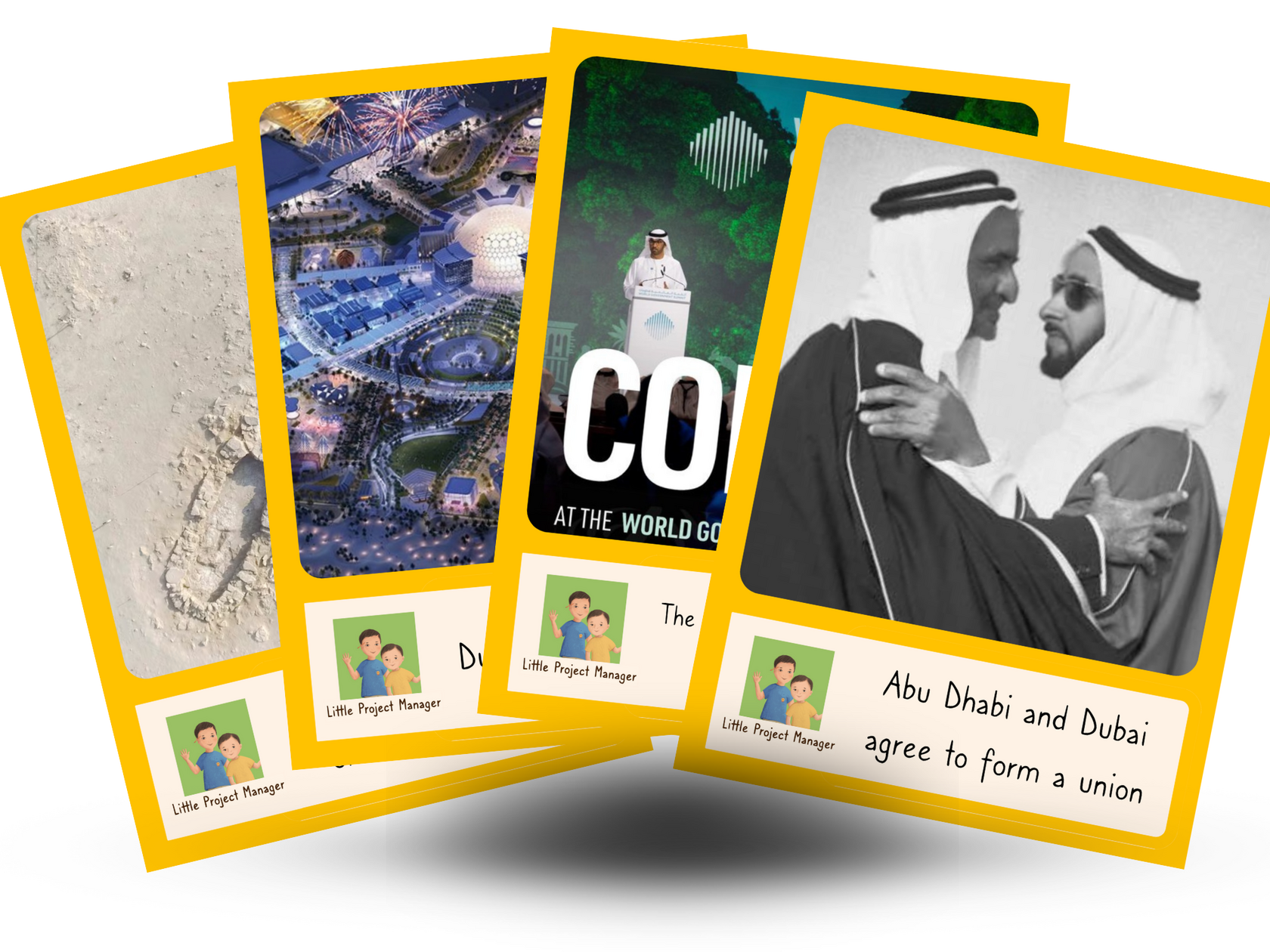
The addition of this timeline to teachers’ MSC displays is an excellent development in promoting children's chronology particularly of this region and yet we should never be content with simply having a poster that runs the risk of becoming wallpaper. That is to say, we want children to engage with and interact with such a timeline. Studies have shown time and time again that experiential learning, with children taking ownership of their learning, is the best way for children to internalise and embed knowledge. One of the great benefits of international schools is that children from all cultures and parts of the world are present in the classroom. It seems obvious then that, if such a timeline can be developed for Emirati history, why not other regions? Indeed, if children were able to create their own timelines then these could be combined to reflect not only a deep cultural heritage of the class, but also even more thoroughly help children to understand that many different events were happening across the world at the same time. In addition, if the objective is to help children learn more about Emirati history, there are very simple exercises, such as creating flashcards based on the events of the Little PM timeline, that can turn this resource into a fun game for lessons or even indoor break times. Furthermore, many of the older and longer periods represented on the timeline are individually very complex and are excellent starting points for deeper research about the past of the region, allowing children to develop their independent research and presentation skills.
This timeline is just the beginning of a deeper and richer understanding of Emirati history: where will you take it?